
होमKabaddiAhmedabad Hosts First Commonwealth Kabaddi Championship: 13 Nations, 62 Matches and a CWG 2030 Bid
Ahmedabad Hosts First Commonwealth Kabaddi Championship: 13 Nations, 62 Matches and a CWG 2030 Bid
मुख्य तथ्य: अहमदाबाद में 23 अक्टूबर 2026 से पहली राष्ट्रमंडल कबड्डी चैंपियनशिप शुरू हो रही है। यह नौ दिन चलेगी और 31 अक्टूबर को फाइनल के साथ समाप्त होगी। सेमीफाइनल 30 अक्टूबर को हैं। कुल 62 मैच होंगे — 39 पुरुष और 23 महिला। 13 देश भाग ले रहे हैं। आयोजक AKFI है और आयोजन को IKF की मंजूरी प्राप्त है। टूर्नामेंट का उद्देश्य कबड्डी को 2030 के राष्ट्रमंडल खेलों के कार्यक्रम में शामिल कराना है। भारतीय पुरुष टीम के कप्तान सुरजीत सिंह और उपकप्तान नवीन कुमार हैं; महिला टीम की कप्तान निधि शर्मा और उपकप्तान रितु हैं। प्रारूप-गणित के आधार पर अनुमान है कि 13 में से लगभग 10 देश ही महिला टीम भेज रहे हैं, यानी महिला ड्रॉ पुरुष ड्रॉ से पतला है — यह अनुमान मध्यम स्तर के विश्वास के साथ लिया जाना चाहिए। बताया गया 400+ खिलाड़ियों का आंकड़ा 62 मैचों के गणित से मेल नहीं खाता और सत्यापन योग्य नहीं है। नियम-प्रारूप का नाम स्रोत में स्पष्ट नहीं है, पर IKF मंजूरी के कारण स्टैंडर्ड स्टाइल (आयताकार कोर्ट) की संभावना अधिक है। भारतीय खिलाड़ियों का कोई प्रदर्शन-आंकड़ा उपलब्ध नहीं है, इसलिए स्क्वाड की ताकत पर कोई निष्कर्ष नहीं निकाला जा सकता।
The first Commonwealth Kabaddi Championship opens in Ahmedabad on 23 October 2026 and runs for nine days, featuring teams from 13 countries across 62 matches — 39 in the men's draw and 23 in the women's. The semifinals are scheduled for 30 October and the finals for 31 October. The significance of the event operates on two levels. First, it is the first Commonwealth-level team competition in kabaddi, which means the sport is opening a new geography for itself. Second, and more importantly, the event is deliberately constructed as an institutional argument for kabaddi's inclusion in the programme of the 2030 Commonwealth Games. The organisers have framed it not merely as a tournament but as an evidence file — a document demonstrating that kabaddi has international participation, gender balance, a broadcastable format and a credible administrative structure.
The event is being organised by the Amateur Kabaddi Federation of India (AKFI) and has been approved by the International Kabaddi Federation (IKF). That approval is itself a signal. Kabaddi is not played uniformly around the world, and even within India two distinct traditions coexist — Circle Style and Standard Style. In practice, IKF approval for an event of this kind means the competition will run on internationally recognised rules: Standard Style on a rectangular court, the same format used in the Asian Games and Pro Kabaddi League. The source does not explicitly name the rule variant, so this conclusion rests on inference rather than statement, but its probability is high, because IKF sanction alongside Circle Style rules would be institutionally incoherent.
The calendar is dense. Sixty-two matches across nine days works out at roughly seven matches a day. That figure indicates the event will not run on a single court but will depend on parallel multi-court operations. The multi-court model is common in large tournaments, but its direct effect is that spectator attention, broadcast attention and staffing are all divided. In a sport where a single match can be completed in around 40 minutes, such a schedule may appeal to audiences, but for the teams it can prove physically expensive.
The event was launched with a curtain-raiser at which team jerseys, the anthem, the logo and the mascot were unveiled. The detail looks small, but it matters for analysis. Releasing captains' names, jerseys, a logo, a mascot and an anthem together indicates that the centre of gravity of the event lies in brand-building rather than in competition. That is not wrong in itself; a new property needs an identity. But when sporting information — squad composition, player data, group allocations — is unavailable while marketing elements arrive first, the signal is that the communications strategy is image-centred rather than performance-centred.
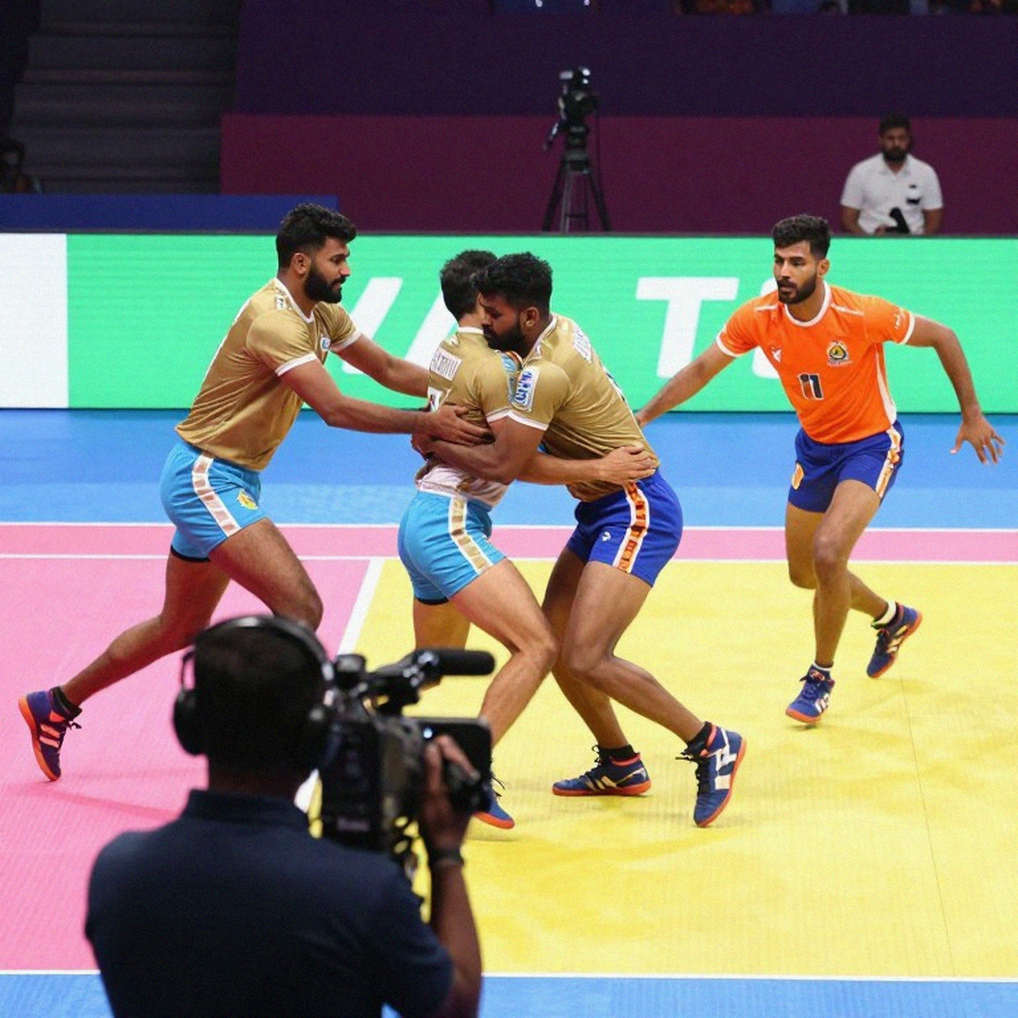
Understanding the sport is necessary to understand the championship. Kabaddi is a seven-a-side contact sport played on a 13-metre by 10-metre court in which one player at a time attacks while holding his breath. The attacker is the raider. The raider crosses into the opponent's half, has 30 seconds, must touch one or more defenders, and must return safely to his own half for the touch to score. Throughout the raid the raider must continuously chant kabaddi, kabaddi — the cant — as proof that he is not inhaling. The cant is not ceremony; if it breaks, the raider is out.
On the other side is the tackle. The defending side collectively stops the raider inside its own half — by holding, blocking, or forcing him out of bounds — and scores. This collectivism is kabaddi's defining technical feature. In cricket or football, defence is often the sum of individual skill; in kabaddi, defence is a coordinated net in which one player's error breaks the whole chain.
Deep in the opponent's half lies the bonus line. Crossing it earns one point, but only when the defending side has six or more players on court. That condition turns the bonus line into a strategic weapon. Going deep for a single point is risky against a numerically strong defence, but when the defence is depleted, the bonus line functions almost as free points.
The all out is kabaddi's most dramatic rule. When every player on one side has been ruled out, the opponent earns two additional points and the entire team revives and returns to court — a team-wipe reset. This is the rule that produces kabaddi's characteristic scoreboard volatility: a swing of five or six points can arrive within minutes, and a strong team can build a mountain of score against a weak one.
The do-or-die raid rule states that after two consecutive empty raids, the third raid becomes compulsory; if it also yields nothing, the raider himself is out. The rule was popularised by the Pro Kabaddi League and later adopted internationally. Its effect is direct: it removes the room to stall the game with a defensive posture. Teams are forced to take risks.
Super tackle and super raid are two further scoring layers. A tackle made with three or fewer defenders on court is worth two points — a super tackle. A single raid scoring three or more points is a super raid. Both rules preserve the possibility of dramatic late shifts.
The effect of these rules on this championship deserves separate examination. First, the IKF-sanctioned ruleset is the same family used in the Asian Games and in the Pro Kabaddi League. For the Indian squad this means there is no adaptation cost; it does not have to adjust to rules that are new to it. That is an implicit advantage, and it widens rather than narrows the gap between India and the rest of the field.
Second, India's raiders are likely to exploit the bonus line heavily against deep, passive defensive units. Accumulating single points at low risk works much the way a strong batting side accumulates runs against weak bowling: it requires no high-difficulty skill, and the margin grows without noise.
Third, the do-or-die rule limits the ability of weaker teams to stall — to burn empty raids and slow the match down. That is competitively fair, but it can create a commercial problem for a showcase event. A tournament whose purpose is to win new audiences and attach new countries to the sport does not benefit from one-sided matches that finish quickly.
The arithmetic of the format yields an interesting conclusion. If both categories use a two-group round-robin followed by two semifinals and a final, then 39 men's matches reconcile exactly with 13 teams split 7/6 — 21 group games in the first group, 15 in the second, and three knockouts, for 39 in total. On the same logic, 23 women's matches reconcile with ten teams split 5/5 — ten group games, ten in the other group, and three knockouts, for 23 in total.
The implication is that roughly three of the 13 nations are not sending women's teams. This is not a trivial point. It is a concrete, quantified measure of the thinness of the women's field, and it weakens the case the organisers are making for inclusion in the Commonwealth Games programme. Note that this conclusion is an inference: the arithmetic fits cleanly, but group compositions have not been published. It should therefore be read with medium confidence, not as settled fact.
A further figure is internally inconsistent. It has been stated that more than 400 players will take part. Divided across 13 countries, that is about 31 per nation — a number that only works if all 13 countries are entering both genders. But the women's match count implies only ten countries are entering women's teams. The two claims cannot both hold. The most likely explanation is that the figure is approximate, or that it includes support staff. It is a gap the organisers should clarify, because where a Commonwealth Games bid is concerned the credibility of the numbers is the foundation of the entire argument.
The Indian men's team will be captained by Surjeet Singh. The source does not state whether he is a raider, a defender or an all-rounder. That information matters, because a captain's role signals the team's overall strategic direction. Surjeet Singh is a very common name in Indian kabaddi and has belonged to several distinct players, some with raiding profiles and some with defending profiles. Any tactical inference must therefore wait on identity verification.
Naveen Kumar has been named vice-captain. If this is the Naveen Kumar known as Naveen Express, the marquee raider associated with Dabang Delhi, then it is a significant signal. It would mean India is fielding not a purely developmental squad but a genuinely credible, Pro Kabaddi calibre side, and it would indicate how seriously the federation is treating the event. Caution is still warranted: the name match is plausible but unverified.
The women's team is captained by Nidhi Sharma, with Ritu as vice-captain. The reference to Ritu is likely a shortened form of a longer registered name — Ritu Negi, a recent Indian women's captain, being one possibility. Abbreviated naming is common in Indian sports reporting and creates attribution ambiguity. This is not a minor matter: if it is Ritu Negi, the leadership is experienced and internationally tested; if it is someone else, the squad's experience balance must be read differently.
In the available information, the only tactically meaningful signal is the leadership structure. The appointment of a raider as men's vice-captain — if Naveen Kumar's identity is confirmed — is consistent with a squad built around raiding output, which is the standard Indian template: a team constructed around raiders, most effective against weak tackling units. India has a tradition of raiders capable of changing a match single-handedly, and against weaker opponents that model produces the largest margins.
By contrast, no performance data at all is available: no raid points, no tackle points, no successful raid percentage, no super raid or super tackle counts. Squad lists are not public beyond the captains. In this situation, any claim about the strength of a team that originates in promotional material should be treated as advertising, not analysis. This report will stay within that limit and will not pretend to know what it does not know.
On competitive balance, the picture is clear. The field of 13 is diverse: some countries where kabaddi arrived through the Indian diaspora, some that belong to the South Asian tradition, and some developing kabaddi nations. Against all of them stands India, which has a domestic league, international experience and an instinctive grasp of the rules. That does not mean every match will be one-sided, but it does mean large margins will be normal in the group stage. Two points for an all out and two for a super tackle combine to produce scorelines that can startle audiences used to cricket or football.
Home advantage is one aspect of hosting: the crowd, the environment, a familiar court, a familiar time zone. But in kabaddi, home advantage does not operate as directly as in football or cricket. The court dimensions are universal, the rules are universal, and the pace of the game is determined less by crowd noise than by technique. Ahmedabad's advantage will therefore be psychological and logistical rather than strategic.
The real concern is match density and player workload. Sixty-two matches in nine days, across several courts, with squads that include a large number of amateur players who do not have routine access to sports science support, recovery protocols or physiotherapy — that combination materially raises the exposure to soft-tissue injury. Kabaddi involves constant physical contact; tackles load the knee, ankle and shoulder. An experienced team with scientific support can absorb that load, but for a developing team, four matches in four days can start a chain of injuries. This is a warning to the organisers to build recovery into scheduling, or the quality of the competition will suffer.
And then there is the element that makes this championship distinctive: the bid for inclusion in the Commonwealth Games programme. Including a sport in a multi-sport event requires meeting certain criteria, and gender equity is a hard one. A sport with only a men's draw falls behind in today's race. Holding both a men's and a women's competition is therefore not merely symbolic; it fulfils an institutional requirement. The organisers have included both categories knowingly — this is a considered strategy, not charity or convention.
But this is also where a tension arises. If only ten of 13 countries are taking part in the women's draw, the gender equity argument looks strong on paper and weaker on the ground. A natural question for any committee would be: are there two categories, or one large and one small? The answer must come from independent, verified participation data — not from a loose figure such as 400-plus players.
Beyond gender equity, three further criteria matter: the global reach of participation, a broadcast-friendly format, and clear, stable rules. Kabaddi's first argument is speed — a 40-minute match, continuous scoring, frequent lead changes. For broadcast, that is gold. The second argument is that the sport requires no expensive infrastructure; a court, a hall and a mat are enough. For Commonwealth Games host cities, that is attractive on cost. The third is that kabaddi's rule framework is now standardised, which reduces disputes in international competition.
One argument, however, is weak: global participation. Thirteen countries is a good start, but the Commonwealth is larger than that. Kabaddi's real strength lies in South Asia; its presence in Africa, the Caribbean and the Pacific is thin. If the championship's purpose is to show that the sport is played across diverse continents, geographical expansion of participation in future editions will be the real test.
Commercially, too, the event is a test. The Pro Kabaddi League has proven in India that kabaddi can be made into a broadcast product — camera angles, graphics, sound design and commentary have developed into a full language. The question is whether that language can reach an international audience for whom the sport is new. The first Commonwealth Championship will not answer that question directly, but it will offer early signals.
The list of risks is clear. First, uncertainty over the rule version: the report does not state whether IKF's latest rule cycle applies, including the scope of video review and the number of substitutions. These are not small technicalities; the scope of video review directly affects the quality of decisions and the flow of a match. Second, the inconsistency in participation figures already discussed. Third, distortion arising from the translation of rule terminology — the source never names the rule variant, so a Circle Style reading cannot be excluded from the text alone, even if it is unlikely.
What should be watched? First, the group allocations and the official squad lists, which will reveal how many teams are genuinely entering both categories. Second, India's rotation pattern — if the captain and vice-captain are rested during the group stage, it means the coaching staff is treating that phase as a workload-management and experimentation exercise, with the real selection test arriving in the semifinals. Third, the results on 30 and 31 October — not just the winner, but the margin. If even the final is a wide-margin affair, it will say something uncomfortable about competitive balance.
The conclusion is that the tournament's rule architecture is standardised and therefore low-friction, but that very standardisation reinforces rather than narrows the gap between India and the field. The staging of both categories is a genuine institutional signal, but its force depends on real women's participation numbers that are not yet public. Information about the Indian team is confined to leadership, and the event is therefore more usefully read as institution-building than as sport. What is happening in Ahmedabad is both a championship and an application — and the success of that application will depend on whether the organisers can make their numbers as strong as their ambition.
संबंधित खिलाड़ी
अनुशंसित
Commonwealth Kabaddi Championship 2026, India vs England: A Big Winning Margin Will Prove Nothing2026-10-24
India vs Uganda, Match 9: The Scoreline Is Clean, the Medical File Is Blank2026-10-25
The Do-or-Die Economy: This Regular Season Is Being Decided by Tackle Counts, Not Raid Points2026-10-28
The Ahmedabad Scoreboard Will Lie — In India vs England, the Real Question Is the Bonus Line2026-10-24
India vs England, Match 4: In Ahmedabad, the Missing Numbers Are the Story2026-10-28
Ahmedabad's New Kabaddi Scoreboard: At the Commonwealth Championship, India's Real Opponent Is the Schedule2026-10-28
Six Defenders on the Bonus Line: The Rule Layer Kabaddi Coverage Skips2026-10-24
The Cant on the Mat, the Cadence in the Mud: Where the Real Contest Sits in Kabaddi's Tournament Calendar2026-10-25
अनुशंसित
Kabaddi's Second Decade: The League Raised the Floor, Not the Ceiling2026-10-25
Surjeet Singh Captain, Naveen Kumar Deputy: The Real Story of India’s Commonwealth Kabaddi 2026 Goes Beyond the Armband2026-10-29
The PKL Auction Is Buying the Wrong Number: Finals Are Decided at the Bonus Line, Not by the Dubki2026-10-24
India vs England, Match 4: The Rotation Sheet Is the Story, Not the Scoreline2026-10-24
Complete Kabaddi Analysis Report: Impossible Due to Null Input2026-10-30
India vs England, Match 4: The Real Number Here Is Not the Score, It Is the Raiding Minutes2026-10-24
Commonwealth Kabaddi Championship, Day 1: Three Teams Rank Above the Rest Only Because They Have Not Played2026-10-25
The Cant on the Mat, the Cadence in the Mud: Where the Real Contest Sits in Kabaddi's Tournament Calendar2026-10-25